Tuesday, April 4, 2017
Coalition Snow Featured in Forbes
Check out Adventures in Shredding Paradigms here, and also hop over to Forbes for their take on Coalition Snow.

Wednesday, March 29, 2017
Springtime Family Fun at Sunshine Village
When many vacationers book spring break escapes to beach resorts,
those of us who feel as if we have missed out on winter are hankering to
hit the slopes. With nary a snowflake to be found near New
York City, mountain resorts out west still have plenty of snow come mid-April. Last April, my family visited the Canadian Rockies to enjoy the late-season slopes.
Sunshine Village in the Canadian Rockies
The bonuses of spring skiing in the Canadian Rockies are plentiful. Beyond the cheap airfare and hotel rates, there is ample slope-side lodging and no crowds. Hop an early flight to Calgary, and you can be stepping into your bindings that afternoon at Sunshine Village resort, just a 20-minute drive from downtown Banff.
 Sunshine's Lookout Mountain has the famed Delirium Dive zone, which is a short hike from the top of the Great Divide Express Quad. Again, this area will most likely be closed in spring conditions. But there are also plenty of steep, bumpy runs down from the peak, which tops out at 8,954 feet. On the other side of Lookout Mountain, the runs under the Tee Pee bubble quad are great in spring conditions because they are protected from the fierce wind that can blow at the top, so the springtime snow stays a bit softer among the tree.

Still, we found some bare spots, but that's to be expected.
Across the valley, the lower Mount Standish has great intermediate and beginner slopes intermingled with steep faces, so families can head down together, split up midway down the mountain, and meet up again at the bottom of the Standish Express Quad. And the WaWa Quad has nicely groomed blue runs, some fun glades and access to lower out-of-bounds steeps.

Ski and Stay
Staying at Sunshine Village is a lot of fun. Visitors park at the bottom of a long gondola and ride up to the lift-side hotel. Check in and hit the slopes right away! Porters bring up the luggage on the gondola, so everything is waiting for you in your room at the end of the day.
Our room was literally steps away from the lifts.
We kept our skis on the patio although ski storage was just one flight below us. It was so easy to pop in to use the bathroom or switch out wet mittens without delay.
Since there isn't a town at the bottom of the lifts, hotel staff run evening activities such as tobogganing and scavenger hunts. The kids were a little young for the hot tub, and there isn't a pool, but we found a pool table in the basement.
Snow School
Lessons at Sunshine Village at this time of year were easy to book at the last minute. Our kids had either one other student with them, or they got a private lesson for the price of a group. Always a plus! The only downside to the ski school was that Ellery was only 5 years old, so she had to go to the day care center for her lesson. She was not happy about this, and the center is a concrete block of a building down past all of the lifts. It was quite a hike back up the hill, especially for a little kid with tired legs. She did enjoy her private "group" lessons, however. Cyane, who was 7 years old, had one other student in her snowboarding class, and we didn't have to hike to the meeting place.
Upcoming Events
Check out the upcoming April events, including ski church and Easter service, girls free ride day, Toyota free ride day, bonfires and Coors Light concerts, the Holy Bowly and much more. ShredAbility in Aid of Rocky Mountain Adaptive is scheduled for April 8th. Sign up for a treasure hunt with your friends and support the cause.
Sunshine Village in the Canadian Rockies
The bonuses of spring skiing in the Canadian Rockies are plentiful. Beyond the cheap airfare and hotel rates, there is ample slope-side lodging and no crowds. Hop an early flight to Calgary, and you can be stepping into your bindings that afternoon at Sunshine Village resort, just a 20-minute drive from downtown Banff.
 | |
| In April, we could stretch out and not fight the crowds. |
Nestled high in the mountains along the British Columbia border, Sunshine Village offers great late-season adventures. The parking lot is a gondola ride away from the slopes, and skiers can either ski out or ride the gondola back to their cars.
Sunshine Village is really three mountains in one. The Goat's Eye peak lift serves some gnarly double-black-diamond chutes and crags that are a short hike from the lift. It's unlikely these will be open in late spring. Meanwhile, the upper face looks like a bulbous racecourse, so still lots of fun for those who enjoy a steep groomer. Down below are gentler blue and green slopes that lead down to the gondola mid-station.
Sunshine Village is really three mountains in one. The Goat's Eye peak lift serves some gnarly double-black-diamond chutes and crags that are a short hike from the lift. It's unlikely these will be open in late spring. Meanwhile, the upper face looks like a bulbous racecourse, so still lots of fun for those who enjoy a steep groomer. Down below are gentler blue and green slopes that lead down to the gondola mid-station.


Still, we found some bare spots, but that's to be expected.
Across the valley, the lower Mount Standish has great intermediate and beginner slopes intermingled with steep faces, so families can head down together, split up midway down the mountain, and meet up again at the bottom of the Standish Express Quad. And the WaWa Quad has nicely groomed blue runs, some fun glades and access to lower out-of-bounds steeps.


Ski and Stay
Staying at Sunshine Village is a lot of fun. Visitors park at the bottom of a long gondola and ride up to the lift-side hotel. Check in and hit the slopes right away! Porters bring up the luggage on the gondola, so everything is waiting for you in your room at the end of the day.
 |
| Ski in/ski out doesn't get any closer than this. |
Since there isn't a town at the bottom of the lifts, hotel staff run evening activities such as tobogganing and scavenger hunts. The kids were a little young for the hot tub, and there isn't a pool, but we found a pool table in the basement.
Snow School
Lessons at Sunshine Village at this time of year were easy to book at the last minute. Our kids had either one other student with them, or they got a private lesson for the price of a group. Always a plus! The only downside to the ski school was that Ellery was only 5 years old, so she had to go to the day care center for her lesson. She was not happy about this, and the center is a concrete block of a building down past all of the lifts. It was quite a hike back up the hill, especially for a little kid with tired legs. She did enjoy her private "group" lessons, however. Cyane, who was 7 years old, had one other student in her snowboarding class, and we didn't have to hike to the meeting place.
Check out the upcoming April events, including ski church and Easter service, girls free ride day, Toyota free ride day, bonfires and Coors Light concerts, the Holy Bowly and much more. ShredAbility in Aid of Rocky Mountain Adaptive is scheduled for April 8th. Sign up for a treasure hunt with your friends and support the cause.
Wednesday, March 1, 2017
Two ski/ride stories on offMetro.com
There is still snow in Vermont!
Check out my latest stories on offMetro.com.
Women's ski and ride clinics

Okemo is a Southern Vermont Gem

Wednesday, February 22, 2017
Little Kids, Big Mountains
You don't have to give up the big mountain experience just because you have little kids.
My family ate lunch today at the summit of Kicking Horse Resort. Clad in our ski and snowboard gear, my two young daughters, my husband and I rode the gondola to the top, and dined at some 8,000 feet up. The view is 360 degrees of spectacularly snowy high cliffs and crags lining valleys that extend for miles. Best of all, the experience wasn't lost on the kids. |
| Photo: Family Snow Time! |
There's no doubt that Kicking Horse has some of the steepest terrain in the Rockies, Canadian or American. The epic double black diamonds draw mostly male skiers and boarders who hike for their runs. So, I was surprised to see how well the resort caters to families with kids.
Kids can take lessons at all levels from the ski and snowboard school. A mid-mountain family zone gives youngsters a place to have fun without speeding experts flying past. Plus, the resort offers lower-mountain-only tickets for lifts that go as high as the mid-station, where there are still plenty of options for all levels.
 |
| Photo: Family Snow Time1 |
Big Bumpy Bowls
When there is plenty of soft, light powder, even the gnarliest moguls become friendly. For a kid on a 110-cm snowboard, those bumps are rolling hills. It seems counter-intuitive, but taken one at a time, the snowy mounds make a steep slope less intimidating.
 |
| Photo: Family Snow Time! |
Upsides and Downsides
There are definitely pluses and minuses to the big mountain experience with kids. Firstly, the run are long. So if kids are cold or tired, this can be challenging for everyone involved. Know where the mid-mountain lodge is and bring toe warmers and snacks.
On the plus side, at a big mountain, you will likely spend more time on the slopes than waiting in line. We had only one 10-min wait at the base of Lake Louise. Once most folks headed to the upper mountain and back bowls, the lines disappeared. Then, the playground of pistes was ours to explore!
Monday, January 30, 2017
Poconos smackdown: Camelback or Shawnee for Learning?
Recently I took my two daughters snowboarding, one day at Shawnee and one day at Camelback. This was my first time at both mountains. Here's how they compare...
Getting there
Shawnee and Camelback are both near the NJ/PA border via Rt. 80. From NJ, Camelback is about 20 minutes further.
Does size matter?
When it comes to ski/board hills, the size of the mountain definitely matters. That said, for a beginner snowboarder, smaller Shawnee mountain was the perfect size. Ellery easily moved from the bunny hill to the green runs from the top of Shawnee, and she even tackled a blue run by the end of the day. Because the runs were short, they didn't overwhelm her little legs. Meanwhile, her more experienced older sister had some fun once we moved to the longer slopes since she was bored on the bunny hill.
Camelback is a bigger mountain than Shawnee, and the green runs from the top are longer. This is great for a kid who is ready for more of a challenge, except for the fact that the green runs were pretty flat -- frustrating on snowboard, as we are discovering. Due to very challenging snow (if you can call it snow), the lower green chairlift run was just right for a wee one.

Meanwhile, the blue runs and terrain park on the far left at Camelback were great for Cyane, who is exploring new types of terrain. Nothing was too steep, and there were plenty of trail choices. Best of all, the crowds stayed on the other side of the mountain because the trek to the far lifts was kind of a drag on a snowboard.
Conditions
Conditions change from day to day, and that is part of the challenge of learning to master the slopes. Shawnee had thin cover on top of hard pack and ice. As long as edges stuck, there was nothing to knock over a little kid (although some out-of-control crazies came close).
Camelback was covered in fabricated snow that was like deep, heavy sand. While actual camels thrive in those conditions, small snowboarders riding 90-cm boards are pretty unhappy. Scratch that... VERY unhappy. The heavy snow piled up on Ellery's board, stopping it and making her face plant. Grains of ice filled her mittens, and it took an elaborate two-layer system using back-up mittens to keep her wrists and hands dry and warm. You know it's bad when your little one says, "Mommy, I like the ice better." Cyane, who outweighs her sister by 20 pounds and rides a 110-cm board, had an easier time in the deep dunes of sand snow, but she struggled in places, too.
Crowds
At these two mountains, the farther away from the lodge we got, the more open space we had. You just have to be willing to schlep to the distant lifts. Both mountains were crowded, especially on the beginner hills. Later in the day and at lunchtime, the crowds thinned.
Crowds are fine as long as skiers and riders know the rules of the slopes: uphill skiers must avoid downhill skiers and skiers must stay in control... that sort of stuff. Ski areas should also figure out better ways to funnel those coming from the advanced slopes away from the beginner slopes rather than onto them.
If you have been to either of these mountains, please share your experience below!
Getting there
Shawnee and Camelback are both near the NJ/PA border via Rt. 80. From NJ, Camelback is about 20 minutes further.
Does size matter?
 |
| Shawnee trail map |
 |
| Camelback trail map |
Camelback is a bigger mountain than Shawnee, and the green runs from the top are longer. This is great for a kid who is ready for more of a challenge, except for the fact that the green runs were pretty flat -- frustrating on snowboard, as we are discovering. Due to very challenging snow (if you can call it snow), the lower green chairlift run was just right for a wee one.

Meanwhile, the blue runs and terrain park on the far left at Camelback were great for Cyane, who is exploring new types of terrain. Nothing was too steep, and there were plenty of trail choices. Best of all, the crowds stayed on the other side of the mountain because the trek to the far lifts was kind of a drag on a snowboard.
Conditions
Conditions change from day to day, and that is part of the challenge of learning to master the slopes. Shawnee had thin cover on top of hard pack and ice. As long as edges stuck, there was nothing to knock over a little kid (although some out-of-control crazies came close).
Crowds
At these two mountains, the farther away from the lodge we got, the more open space we had. You just have to be willing to schlep to the distant lifts. Both mountains were crowded, especially on the beginner hills. Later in the day and at lunchtime, the crowds thinned.
Crowds are fine as long as skiers and riders know the rules of the slopes: uphill skiers must avoid downhill skiers and skiers must stay in control... that sort of stuff. Ski areas should also figure out better ways to funnel those coming from the advanced slopes away from the beginner slopes rather than onto them.
If you have been to either of these mountains, please share your experience below!
Tuesday, January 10, 2017
Adventures in Shredding Paradigms
PART 2: What does 'adventure' mean to you?
It's the sort of question that gets the gears clinking in the brain and the blood pumping through the veins a wee bit. This question was also the raison d'etre of the SHE VENTURES event in New York last fall.
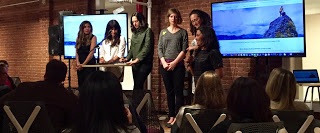
In part two of this series, in which I feature each speaker from SHE VENTURES NYC in a separate post, I shine the spotlight on Jen Gurecki, a positive driving force behind SHE VENTURES, and social change for women.
Gurecki, the recent founder of a women-run ski and snowboard company called Coalition Snow, got involved with SHE VENTURES when founder Georgina Miranda asked her to help coordinate the series. "I think women are interested in hearing stories by other women that are perceived as doing things that are difficult, like starting a business or doing epic outdoor adventures," says Gurecki. Each SHE VENTURES program raises awareness about women's issues, while also raising funds for charitable organizations. The New York City event supported the International Medical Corps.
 |
| Courtesy of Coalition Snow |
"There is a level of camaraderie that women crave," Gurecki explains. "That might lead to helping to raise funds for a nonprofit or supporting women speakers and leaders. And maybe they'll make some good connections at the same time. It’s a recipe for success."
Making Fresh Tracks
One could argue that successful recipes have a variety of components that work together harmoniously to create something awesome. According to Gurecki, most current recipes for making women's skis are not successful. As she describes it, "Women’s skis have always been watered down and are sub-optimal in comparison to men’s. We didn’t make up the phrase “shrink it and pink it.” That was the go-to for women’s ski design."
So on a backcountry ski trip, Gurecki and friends were talking about the evolving state of women's involvement in the snow sports industry. "Professional female athletes were becoming more outspoken and publicly demanding more respect. That was fascinating to me," says Gurecki, who thought it would be an interesting time to shift the perspective of women skiers and snowboarders... and ski and snowboard makers.
The idea stuck. After doing some research and designing in 2013, Gurecki and shredding colleague Meghan Kelly toted ski and board prototypes to the Lewis Glacier, located some 16,355 feet up on Africa's Mt. Kenya. There, they cut fresh tracks, but not just in the snow. This trip broke new ground for women in snow sports.
 |
| Courtesy of Coalition Snow |
The trip also raised $16,355 to support Zawadisha, a not-for-profit that Gurecki founded in 2013 to provide micro-loans to rural Kenyan women whose lives are directly affected by a changing climate. Zawadisha also provides educational programs and support groups among local villages to help improve women's daily lives and livelihoods. You might say that empowering women is Gurecki's thing. Check out her TED talk called, “Rethinking the Paradigm of Poverty.”
Coalition Building
Coalescing, according to Merriam-Webster, is the act of uniting or joining together into one body or product. Started in 2014, Coalition Snow is doing just that. After the Lewis Glacier trip, Gurecki gathered women skiers and boarders to work together to create products that are not watered-down versions of what are designed for men. As Coalition Snow advertises,
"We make women's skis and snowboards that don't suck."
 |
| Courtesy of Coalition Snow |
Coalition Snow is a company run by female powderhounds, so there isn’t a gap between the design and the end users. While there are many emerging brands for women, it appears that those companies are run by men. "When we came up with the name Coalition, I had this image of women side by side, supporting and moving each other forward," says Gurecki. "When you support Coalition Snow, you are supporting women in business. You are supporting a company that is creating opportunities for women in a male-dominated industry."
More than a Hashtag
During her SHE VENTURES talk, Gurecki posed the following question: "Do we as women own and benefit from the exploding hashtags of the women phenomenon that is sweeping the outdoor industry?"
As she rides the highs and lows of building a company, she challenged women to differentiate between "likes" and real change for women. Gurecki's "She" adventures are putting ideas into action on the ground in Kenya, on the slopes and in the boardroom (literally). She wrapped up her talk with a kick in the pants, saying, "I want to be more than just a hashtag... do you?"
Saturday, December 24, 2016
Join the World's Largest Group Lesson
It sounds crazy, but it's true! On January 6th, 2017, you can help set a new world record for the Largest Ski and Snowboard Group Lesson.
Skiers and boarders in the US and Canada are welcome to participate. All levels are welcome to take part in what is bound to be a fun day to make history! Quite a few eastern mountains are hosting, and you can find one close to you with this list and interactive map of US locations. The Canadian Ski Council has a list of Canadian areas that are joining in.
The organizers tried this last year, but evidently they didn't have sufficient proof of the 6,000 or so students who took part. So, they have called for an official do-over.
All lessons will take place simultaneously in seven different time zones:
9 am Alaska time
10 am Pacific time
11 am Mountain time
12 noon Central time
1 pm Eastern time
2 pm Atlantic time
2:30 Newfoundland time
This colossal event is being coordinated by the Learn to Ski and Snowboard Initiative, the National Ski Areas Association, Professional Ski Instructors of America, SnowSports Industries America and SNOW Operating.
 |
| Photo courtesy of PSIA-AASI |
The organizers tried this last year, but evidently they didn't have sufficient proof of the 6,000 or so students who took part. So, they have called for an official do-over.
All lessons will take place simultaneously in seven different time zones:
9 am Alaska time
10 am Pacific time
11 am Mountain time
12 noon Central time
1 pm Eastern time
2 pm Atlantic time
2:30 Newfoundland time
This colossal event is being coordinated by the Learn to Ski and Snowboard Initiative, the National Ski Areas Association, Professional Ski Instructors of America, SnowSports Industries America and SNOW Operating.
Wednesday, November 30, 2016
Staying Dry = Staying Warm
If you are like me, you have struggled to keep those pinkies and piggies warm when Jack Frost comes to visit. Whether you are on the slopes, at the ice rink or out for a wintry walk, you can fend off frozen footsies with a few simple rules of thumb. I'm not saying you won't eventually get too cold, but you can at least extend the fun.
Stay Dry
This is the most important, and perhaps the most difficult. In fact, any other rules lead back to this one. Once your mittens and socks get wet, your extremities will start to get cold. Here are some tricks I've learned over the decades -- and I use them on my kids, too. Good snow gear isn't cheap, but it is worth the extra money if everyone stays dry and warm.
NO COTTON:
Nope. Nada. None. Anywhere. You are just asking to be cold if you wear cotton. 'Nuff said.
 Strong elastic on the bottom of ski/snow pants: Don't skimp here. Buy snow pants--especially for kids-- with strong elastic on the boot cuffs. You need something strong so that cuff can go over the top of a snow boot and STAY. Otherwise, snow will go inside the boot.
Tall boots:
You need boots that are tall enough for the pants liner to cover. The taller the better for keeping snow out.
Velcro on ends of sleeves:
 Again, the key is to keep the snow out and the mittens on. I always tuck my gloves inside my sleeves. For kids, you can buy mitts with long sleeves that go up to the elbows. Fleece cuffs inside the jacket sleeves also help keep out snow.
Fleece inside the collar:
For those windy cold days.
Powder skirt:
Some jackets have an elastic waist the snaps in the front to help keep snow from going up inside when sledding or yard saling. Weak elastic doesn't do any good here.
Removable hood:
It is good to have the option to remove the hood for warmer days.
No short jackets:
I loved my blue corduroy short-waisted CB jacket from the late 1970's. But I also got a lot of snow up my shirt and down my pants whenever I wiped out skiing (which was a lot). Get a jacket that covers the backside--at least partly.
Pit zips:
 For me, this is a must. Zippers under the armpits provide ventilation so I don't soak my inner layers. I unzip on the way down and zip up on the lift. New jackets may have mesh to help keep out snow in case of a face plant. Not many kid jackets have them, probably because it is one more thing to manage.
Nifty extras:
Snow pants and jackets often have a plastic loop or nob near the waist for a lift ticket so it isn't flapping in the face. Inside pockets are handy, too, for tissues, ipods or phones. Also, a lot of kiddie outerwear has a "growth ring" that can be let out to extend boot cuffs or sleeves to accommodate growth spurts.
Glove and sock liners:
My sweaty hands get cold instantly when I stop moving. Glove liners--inside my mittens--are the only things that keep them warm enough for me to keep skiing. I bring an extra pair so I can change them at lunchtime. Sock liners are hard to find these days (I tried in Banff last year). A thin silk sock does the trick, though.

Gloves v mittens:
You may have to experiment to see what works best for you and your kids. Mittens are generally warmer than gloves, though. I usually wear mittens, and I can wear gloves only on warm, sunny days. I have old mittens with a zipper on the side (I think so you can slip in a heat pack) that I use as a vent. I can also squeeze my hand out to use my phone, etc. without taking off my mittens. E-tip glove liners also help w/ answering the phone and snapping pics.
Either way, I usually carry a backpack with a change of gloves, mitts and liners for me and my kids. I might throw in some extra socks, too.
Pants v bibs:
Bibs are good for kids to keep out the snow since they do tend to fall down a lot. For grown ups... bibs are probably a good option for a beginner, but they do look a little weird on adults, sort of the way footie PJs would look. I wear ski pants with a longer jacket (shell usually) that doesn't have a lot of wiggle room for snow to get in.

Long johns:
Comfy non-cotton tights or long johns and a long-sleeved top are perfect for a base layer. Like glove and sock liners, this layer will help whisk moisture away from your skin. A turtleneck is a good option on a cold day. You probably don't need another layer except ski pants on your legs. If your pants are just shells, wear fleece tights underneath on a cold day.
Middle layer:
On top, I wear either a fleece vest or a thin fleece t-neck sweater with a zipper.
Don't overdo:
Wear enough layers to keep you warm, but not too many that you can't vent moisture once you start to move.
Stay hydrated:
I tuck a water bottle or two in that backpack of extras. It is a good idea to stay hydrated even if you are cold.
Helmets:
Wear a helmet to ski or snowboard. Put helmets on your kids. Even if it's warm. Adjust the chin strap properly. You just never know.
Stay Dry
This is the most important, and perhaps the most difficult. In fact, any other rules lead back to this one. Once your mittens and socks get wet, your extremities will start to get cold. Here are some tricks I've learned over the decades -- and I use them on my kids, too. Good snow gear isn't cheap, but it is worth the extra money if everyone stays dry and warm.
NO COTTON:
Nope. Nada. None. Anywhere. You are just asking to be cold if you wear cotton. 'Nuff said.
 Strong elastic on the bottom of ski/snow pants: Don't skimp here. Buy snow pants--especially for kids-- with strong elastic on the boot cuffs. You need something strong so that cuff can go over the top of a snow boot and STAY. Otherwise, snow will go inside the boot.
 Tall boots:
You need boots that are tall enough for the pants liner to cover. The taller the better for keeping snow out.
Velcro on ends of sleeves:
 Again, the key is to keep the snow out and the mittens on. I always tuck my gloves inside my sleeves. For kids, you can buy mitts with long sleeves that go up to the elbows. Fleece cuffs inside the jacket sleeves also help keep out snow.
 Fleece inside the collar:
For those windy cold days.
Powder skirt:
Some jackets have an elastic waist the snaps in the front to help keep snow from going up inside when sledding or yard saling. Weak elastic doesn't do any good here.
Removable hood:
It is good to have the option to remove the hood for warmer days.
No short jackets:
I loved my blue corduroy short-waisted CB jacket from the late 1970's. But I also got a lot of snow up my shirt and down my pants whenever I wiped out skiing (which was a lot). Get a jacket that covers the backside--at least partly.
Pit zips:

Nifty extras:
Snow pants and jackets often have a plastic loop or nob near the waist for a lift ticket so it isn't flapping in the face. Inside pockets are handy, too, for tissues, ipods or phones. Also, a lot of kiddie outerwear has a "growth ring" that can be let out to extend boot cuffs or sleeves to accommodate growth spurts.
Glove and sock liners:
My sweaty hands get cold instantly when I stop moving. Glove liners--inside my mittens--are the only things that keep them warm enough for me to keep skiing. I bring an extra pair so I can change them at lunchtime. Sock liners are hard to find these days (I tried in Banff last year). A thin silk sock does the trick, though.

Gloves v mittens:
You may have to experiment to see what works best for you and your kids. Mittens are generally warmer than gloves, though. I usually wear mittens, and I can wear gloves only on warm, sunny days. I have old mittens with a zipper on the side (I think so you can slip in a heat pack) that I use as a vent. I can also squeeze my hand out to use my phone, etc. without taking off my mittens. E-tip glove liners also help w/ answering the phone and snapping pics.
Either way, I usually carry a backpack with a change of gloves, mitts and liners for me and my kids. I might throw in some extra socks, too.
Pants v bibs:
Bibs are good for kids to keep out the snow since they do tend to fall down a lot. For grown ups... bibs are probably a good option for a beginner, but they do look a little weird on adults, sort of the way footie PJs would look. I wear ski pants with a longer jacket (shell usually) that doesn't have a lot of wiggle room for snow to get in.

Long johns:
Comfy non-cotton tights or long johns and a long-sleeved top are perfect for a base layer. Like glove and sock liners, this layer will help whisk moisture away from your skin. A turtleneck is a good option on a cold day. You probably don't need another layer except ski pants on your legs. If your pants are just shells, wear fleece tights underneath on a cold day.
Middle layer:
On top, I wear either a fleece vest or a thin fleece t-neck sweater with a zipper.
Don't overdo:
Wear enough layers to keep you warm, but not too many that you can't vent moisture once you start to move.
Stay hydrated:
I tuck a water bottle or two in that backpack of extras. It is a good idea to stay hydrated even if you are cold.
Helmets:
Wear a helmet to ski or snowboard. Put helmets on your kids. Even if it's warm. Adjust the chin strap properly. You just never know.
Tuesday, November 29, 2016
Ski Bums for 2017
I couldn't resist a post about this recent find for the holidays--although some may say the topic is not entirely "family friendly."
If you are like me, you still use a paper wall calendar. Instead of animals or nature scenes for 2017, I'm going with ski bums -- literally!
The World Cup Dreams Foundation, a 501 C3 Non-Profit organization, is selling the Under the Suit: Bodies of the Ski Team 2017 calendar that is chock full of nude racers. Why? Proceeds will help support travel, training and competition costs for unfunded US Ski Team athletes.
According to the web site, "Athletes on the [National] Ski Team who are below the A-Team level have to pay for their travel expenses. This can range from between 15,000 - 35,000 dollars per year."
The calendar goes for $60, or a bundle of 3 for $120 or 5 for $200. True ski fans can buy one of 10 limited-edition copies signed by Ted Ligety for $750.
If you are like me, you still use a paper wall calendar. Instead of animals or nature scenes for 2017, I'm going with ski bums -- literally!
The World Cup Dreams Foundation, a 501 C3 Non-Profit organization, is selling the Under the Suit: Bodies of the Ski Team 2017 calendar that is chock full of nude racers. Why? Proceeds will help support travel, training and competition costs for unfunded US Ski Team athletes.
 |
According to the web site, "Athletes on the [National] Ski Team who are below the A-Team level have to pay for their travel expenses. This can range from between 15,000 - 35,000 dollars per year."
The calendar goes for $60, or a bundle of 3 for $120 or 5 for $200. True ski fans can buy one of 10 limited-edition copies signed by Ted Ligety for $750.
Tuesday, November 22, 2016
To Ski School or Not to Ski School...Is There a Question?
When I was a kid, it never occurred to my parents that ski lessons would be helpful for me and my brothers. We were pretty much left to our own to figure out what to do -- with short lace-up boots and wooden skis at Big (it wasn't) Rock Candy Mountain in Speigletown, NY. For us, skiing was as much about surviving the rope tow and T-bar as it was shear luck that we didn't seriously hurt others as we careened en masse toward the bottom of the hill.
Then in 1991 I moved to Jackson Hole, Wyoming. I became a kids ski instructor--chosen most likely because I was a short, young woman. Through training sessions and teaching, I practiced the basics of skiing over and over... and over. After 15 years or so of skiing, I had
FINALLY learned how to ski, and I could ski slopes that I had never imagined heading down.
"The mountain experience is what skiing and riding is all about. There is so much more than the beginner hill or intermediate run out there," says Jeb Boyd, who manages the national team for the Professional Ski Instructors of America – American Association of Snowboard Instructors (PSIA-AASI). "The more skills you have, the more of the mountain you can access with confidence. "
Start 'em Right
I started both of my kids on skis when they were three years old. Today's tall boots, magic carpets and tiny, shaped skis make skiing a lot easier for wee ones today than in the 1970s. But there are still moments when gravity takes over, and their little brains panic and forget all about making pizza slices with their skis to stop. (That's what helmets are for, right?)
Even though I have solid tools to teach kids to ski, once they were old enough I signed up my girls for lessons. Why? Besides the fact that it is a form of babysitting, a good lesson gives kids fun, new ways to learn how to turn and stop. (Plus, my kids are more likely to listen to someone else than to Mom!)
" A lot of resorts have 'adventure terrain' for the kids," says Boyd. "Sometimes there are little surprises like animal cut-outs around the corner, and there are some secret trails. Those areas are controlled and safe. There may even be a story associated with the space, and it becomes a little adventure for the kids."
Beware the Clueless
Lessons help keep everyone safe on the mountain. "There is a responsibility code that is sort of the rules of the road for the mountain," he says. But unlike the actual road, you aren't tested before you can hit the slopes.
Last year at Campgaw Mtn in NJ, a man with no apparent skiing ability was on the bunny slope "teaching" his daughter to ski. They both fell down a lot, and he didn't know how to explain to his kid how to stop--or turn--at least in an effective way. The girl ran into poor Ellery and knocked her over--three times in one bunny run! There was no escaping them because they didn't have the skill to keep themselves away from us. Ellery wasn't seriously hurt, but her tears were filling up her goggles.
"There are always some difficult situations. They were breaking the skier responsibility code," says Boyd. "If they were running into you, that is a safety concern." The rules are also just common sense. The first item listed on the responsibility code is "Always stay in control, and be able to stop or avoid other people or objects."
Building Confidence at Any Age
As with so many things, having the skills to control our own experiences builds confidence. And confidence generally translates to having fun. Whether you are eight or 48, a lesson helps at any age and any stage.
"Skiing and riding are lifetime sports, but for most people, their confidence level is their threshold," says Boyd. He explains that even though the equipment today practically has turns built into it, you still need to know how to move and control your body to get the ski or board to do what you want in changing conditions and situations.
A few years back, my husband and I took lessons down some of the chutes at Jackson Hole and around the monster bumps at Mad River Glen. The lessons helped me get a feel for my new skis and gave me knew ways to think about how to handle whatever is in front of me, which helped me regain some confidence that I had lost over the years.
Meanwhile, now that our daughter Cyane is snowboarding, lessons are a must to teach her beyond the most basic skills. With the help of instructors at Okemo, Campgaw, Lake Louise and Sunshine Village, Cyane went from barely boarding the bunny hill to tackling toe-turns on Blue slopes in one season. She's thrilled that she gets to ride the chairlift and get up to the top of most mountains--as long as there is a Blue run down.
School's In Session
There are a lot of ski and snowboard instructors out there, but are they all good? According to PSIA-AASI, as of 2014-15, there are more than 32,000 certified "snowsport professionals," which means they have taken training courses and passed knowledge and skill requirement tests. As Boyd explains, many resorts hire instructors that may not be PSIA-AASI certified, but the instructors themselves go through in-house training to insure they have solid basic skills and the ability to communicate with their students.
"An instructor needs three things," says Boyd. "First is technical ability. Next is the ability to create an experience so students can get a result. Third, you have to be a good people person. You can be the best skier, but if no one likes skiing with you, you won't succeed as an instructor."
Boyd, who is based at Cannon Mountain in NH, has been a member of PSIA-AASI for more than 30 years. He says that the best time to take a lesson is whenever you are at the mountain! Some resorts offer lesson and lodging packages. You might learn about some parts of the mountain you didn't know about before or might not be brave enough to explore on your own. Plus, you get to skip the lift line!
Family Fun
Lessons don't have to last all day, and afterward, your kids will love to show you what they have mastered. Last season, Ellery couldn't wait to show us how she could maneuver through the trees on a secret kids trail that she used during her ski lesson at Sunshine Village. She even knew the way back to the gondola. Her lessons had given her the confidence to have fun, relax and find her way through the trails. That translated to a fun family experience for all of us. Money well spent!
Some Resources
PSIA-AASI has information about instructor certification
Kids on Lifts has tips about chairlift safety
National Ski Areas Association has some ski and snowboarding tips.
The Ridge Report has some helpful tips on starting kids on the slopes.
Then in 1991 I moved to Jackson Hole, Wyoming. I became a kids ski instructor--chosen most likely because I was a short, young woman. Through training sessions and teaching, I practiced the basics of skiing over and over... and over. After 15 years or so of skiing, I had
 |
| photo: (c) PSIA-AASI |
"The mountain experience is what skiing and riding is all about. There is so much more than the beginner hill or intermediate run out there," says Jeb Boyd, who manages the national team for the Professional Ski Instructors of America – American Association of Snowboard Instructors (PSIA-AASI). "The more skills you have, the more of the mountain you can access with confidence. "
Start 'em Right
 |
| (c) Family Snow Time! |
Even though I have solid tools to teach kids to ski, once they were old enough I signed up my girls for lessons. Why? Besides the fact that it is a form of babysitting, a good lesson gives kids fun, new ways to learn how to turn and stop. (Plus, my kids are more likely to listen to someone else than to Mom!)
" A lot of resorts have 'adventure terrain' for the kids," says Boyd. "Sometimes there are little surprises like animal cut-outs around the corner, and there are some secret trails. Those areas are controlled and safe. There may even be a story associated with the space, and it becomes a little adventure for the kids."
Beware the Clueless
Lessons help keep everyone safe on the mountain. "There is a responsibility code that is sort of the rules of the road for the mountain," he says. But unlike the actual road, you aren't tested before you can hit the slopes.
Last year at Campgaw Mtn in NJ, a man with no apparent skiing ability was on the bunny slope "teaching" his daughter to ski. They both fell down a lot, and he didn't know how to explain to his kid how to stop--or turn--at least in an effective way. The girl ran into poor Ellery and knocked her over--three times in one bunny run! There was no escaping them because they didn't have the skill to keep themselves away from us. Ellery wasn't seriously hurt, but her tears were filling up her goggles.
"There are always some difficult situations. They were breaking the skier responsibility code," says Boyd. "If they were running into you, that is a safety concern." The rules are also just common sense. The first item listed on the responsibility code is "Always stay in control, and be able to stop or avoid other people or objects."
Building Confidence at Any Age
As with so many things, having the skills to control our own experiences builds confidence. And confidence generally translates to having fun. Whether you are eight or 48, a lesson helps at any age and any stage.
"Skiing and riding are lifetime sports, but for most people, their confidence level is their threshold," says Boyd. He explains that even though the equipment today practically has turns built into it, you still need to know how to move and control your body to get the ski or board to do what you want in changing conditions and situations.
A few years back, my husband and I took lessons down some of the chutes at Jackson Hole and around the monster bumps at Mad River Glen. The lessons helped me get a feel for my new skis and gave me knew ways to think about how to handle whatever is in front of me, which helped me regain some confidence that I had lost over the years.
Meanwhile, now that our daughter Cyane is snowboarding, lessons are a must to teach her beyond the most basic skills. With the help of instructors at Okemo, Campgaw, Lake Louise and Sunshine Village, Cyane went from barely boarding the bunny hill to tackling toe-turns on Blue slopes in one season. She's thrilled that she gets to ride the chairlift and get up to the top of most mountains--as long as there is a Blue run down.
 |
| photo: (c) PSIA-AASI |
There are a lot of ski and snowboard instructors out there, but are they all good? According to PSIA-AASI, as of 2014-15, there are more than 32,000 certified "snowsport professionals," which means they have taken training courses and passed knowledge and skill requirement tests. As Boyd explains, many resorts hire instructors that may not be PSIA-AASI certified, but the instructors themselves go through in-house training to insure they have solid basic skills and the ability to communicate with their students.
"An instructor needs three things," says Boyd. "First is technical ability. Next is the ability to create an experience so students can get a result. Third, you have to be a good people person. You can be the best skier, but if no one likes skiing with you, you won't succeed as an instructor."
Boyd, who is based at Cannon Mountain in NH, has been a member of PSIA-AASI for more than 30 years. He says that the best time to take a lesson is whenever you are at the mountain! Some resorts offer lesson and lodging packages. You might learn about some parts of the mountain you didn't know about before or might not be brave enough to explore on your own. Plus, you get to skip the lift line!
Family Fun
 |
| (c) Family Snow Time! |
Some Resources
PSIA-AASI has information about instructor certification
Kids on Lifts has tips about chairlift safety
National Ski Areas Association has some ski and snowboarding tips.
The Ridge Report has some helpful tips on starting kids on the slopes.
Sunday, November 20, 2016
SNOW in NJ...and elsewhere?

It snowed! It's just a dusting, which will be gone in an hour most likely. But there was officially snow on the ground when I walked the dogs through our neighborhood at 7:00 this morning.
Despite the cold wind blowing in my face, I reveled in the fact that ski mountains would soon be making snow.
According to Hunter Mountain's recorded message, the mountain is currently closed for winter operations, but they hope to open Friday Nov 25th, weather permitting.

Hunter, located in the Catskill Mountains, NY, plans to make more snow through Tues eve as long as temperatures stay low enough. Meanwhile, the weather report looks promising, too!
A little further north, Jiminy Peak in Hancock, MA also plans to open on Nov 25th. Personally, I would much rather have a White Friday than a Black Friday after a day of ritual gluttony. (If I still fit into my ski pants, that is!)
More norther mountains, such as Sugarbush in Warren, VT, advertise Weds, Nov 23rd as opening day. "Sunday River in Newry, ME, tweets: Opening Day is planned. Wednesday Nov 23, but if we can open before, we will!"
Subscribe to:
Posts (Atom)